
Why Validation Before Perspective- Taking Matters
Place a small black dot on a clean white sheet of paper and ask someone what they see. Most people will name the dot first.
My client told me a story about how their dad used to use this metaphor as a lesson about perspective. We focus on the flaw, the problem, the one painful mark, while missing all the white space around it. Perspective matters. Gratitude matters. A wider view can soften pain and help us remember that one hard moment is not the whole story. They shared this story with me because it was a helpful moment, a valuable lesson taught by their dad.
I've been thinking of this story a lot lately. This client is an anomaly. I believe that speaks to the type of relationship they had with their dad, their bond was strong. Typically client's don't share how helpful perspective taking is when they are in distress. That's because there is another truth that often gets skipped.
If you were about to write a letter, draw a picture, or start a story, that black dot would matter. You wanted a blank page. You expected a clean surface. The dot is not meaningless just because the white space is larger.
So what is missing when we simply offer perspective in response to an emotional reaction? We miss the heart of the matter for that other person when we don't validate the emotional experience before teaching perspective. This does not mean every reaction is accurate or every fear should lead the way. It means people usually cannot take in a wider view while they feel dismissed, corrected, or alone.
This idea applies far beyond therapy. It shows up in parenting, marriage, friendship, dating, caregiving, and any relationship where one person wants another person to “see the whole page.”

The black dot gets our attention for a reason
The human mind is not careless because it notices the black dot. It is doing what minds often do. It scans for what feels wrong, risky, unfinished, or painful.
A clean sheet of paper holds possibility. It can become a grocery list, a sketch, a poem, a note tucked into a lunchbox, or the start of a hard conversation. The dot changes the page. It may not ruin the page, but it alters the experience of it.
That matters in relationships.
A child who had a mostly good day may melt down over one teasing comment at recess. A partner who received kindness all week may fixate on one sharp tone during dinner. A friend may replay the one missed invitation instead of remembering all the times they were included.
From the outside, it is tempting to say:
“Look at everything that went right.”
“You’re focusing on the negative.”
“It’s not that big of a deal.”
“You’re missing the bigger picture.”
Those comments may be factually true in part. They may even come from love. Yet they often land as correction, not care.
When someone is focused on the dot, they are usually not asking for a lecture on the square footage of the white paper. They are saying, in some form, “This mark has affected me. Can you see that?”
Perspective helps only after the nervous system feels seen
Perspective is a higher-level skill. It asks a person to zoom out, compare, reflect, and hold more than one truth at a time. That takes emotional bandwidth.
When someone feels hurt, scared, ashamed, or rejected, the body may not be ready for that kind of zooming out. The nervous system moves toward protection. A child cries. A partner withdraws. A friend becomes defensive. A parent snaps. The reaction may look exaggerated if you only look at the present moment.
The presenting problem is rarely just the surface behavior. The question becomes, what emotional alarm is going off, and what does this person need in that moment?
A child upset about a “ruined” drawing may not only be upset about the drawing. They may feel disappointed, powerless, or embarrassed. A partner upset about a forgotten text may not only be upset about the text. They may feel unimportant, alone, or uncertain about their place in the relationship.
If the first response is perspective, the person may hear, “Your alarm is wrong.”
If the first response is validation, the person may hear, “I understand that alarm is loud right now. I’m with you.”
That difference changes what becomes possible next.
Validation does not mean agreement. It means the emotion makes sense when you understand the person’s experience.
This point is easy to miss. Many people avoid validation because they fear it will make the feeling stronger or approve of a behavior. In practice, validation often lowers the intensity because the person no longer has to fight to prove their pain is real.
A child who hears, “You worked hard on that drawing, and that little mark feels so frustrating,” may calm faster than a child who hears, “It’s only one dot. Just use the rest of the page.”
A spouse who hears, “When I looked at my phone during that conversation, it felt like I left you alone in it,” may soften more than one who hears, “I was listening. You’re overreacting.”
The wider view can come later. First, the emotional reality needs a place to land.

Emotion before Meaning
It is important to slow down enough to notice what is happening, both inside the other person and between you and that person.
Rather than rushing to advice, try practicing this instead:
Notice the emotional reaction
What is the person feeling on the surface? Anger, sadness, panic, frustration, shame, numbness?
Validate the emotional logic
Why does the feeling make sense from inside their experience?
Find the deeper need
Do they need comfort, reassurance, safety, repair, respect, closeness, or room to breathe?
Name the protective move
Are they criticizing, shutting down, pleasing, controlling, withdrawing, or trying to fix?
Invite a wider perspective
Once the person feels seen, what else might also be true?
This order matters.
Many relationship conflicts get stuck because people try to start at step five. They lead with the zoomed-out view before they have honored the emotional impact.
For example, imagine a teenager comes home crushed because they were not invited to a weekend plan. A parent may see the larger picture right away. The teen has other friends. This one event will pass. There may be no cruel intent. The parent wants to help the teen not spiral.
A perspective-first response might sound like:
“You have plenty of friends. Don’t let one thing ruin your day.”
A validation-first response might sound like:
“Ouch. That really hurts. You thought you were part of that group, and now you’re wondering if you matter to them.”
The second response does not trap the teen in pain. It gives the pain words. Once the teen feels understood, the parent can later say:
“Do you want help thinking through what else might be going on, or do you just want me to sit with you for a minute?”
That is perspective with permission. It respects timing.
The black dot is often a signal, not the whole story
In intimate relationships, the black dot is rarely only about the black dot.
A forgotten errand becomes, “I can’t count on you.”
A distracted conversation becomes, “I’m not important.”
A short reply becomes, “You’re pulling away.”
A critical comment becomes, “I’m failing you.”
These meanings may not be fully accurate, but they are emotionally real. They usually form from history, attachment needs, stress, and past hurts. If the other person responds only to the surface accusation, the conversation can quickly become a debate.
One person says, “You don’t care.”
The other says, “That’s ridiculous. Look at everything I do for you.”
Now both people are staring at different parts of the page. One sees the dot. The other sees the white space. Both feel unseen.
When this happens, it's important to slow this down so that instead of arguing with the conclusion first, it listens for the ache underneath it.
That might sound like:
“I don’t agree that I don’t care, but I can hear that you felt really alone when I forgot. I want to understand that.”
This kind of response does two things at the same time. It does not accept a false global statement as fact, and it does not dismiss the feeling underneath it. That balance is hard, and it is deeply useful.
Here is a simple way to think about it:
Perspective without validation can feel like correction.
Validation first helps the person feel safe enough to see more.
Validation without perspective can leave people stuck in the pain.
Perspective later helps the person remember the dot is not the whole page.
Both matter. The order makes the difference.

Parents can validate pain without surrendering leadership
Parenting often brings up the fear that validation will make children fragile, entitled, or dramatic. Many caregivers worry that if they acknowledge the black dot, the child will never learn to see the white space.
The opposite is often true. Children learn perspective best from adults who first help them regulate.
A child who is crying because their sibling marked their paper does not need an instant lesson on gratitude. They need help with disappointment, anger, and loss of control. After that, they may be able to problem-solve.
A validation-first parenting response could sound like:
“You wanted a clean page for your picture. I get why that dot feels so upsetting.”
Then, once the child settles:
“Let’s look at what choices we have. We can get a new paper, turn the dot into part of the drawing, or use the back.”
This teaches several skills at once:
Feelings can be named.
Disappointment can be survived.
Problems can have options.
A mark on the page does not have to end the story.
That is not permissive parenting. It is emotionally attuned leadership.
The same pattern works with older children and teens. A teen upset about a low grade may need validation before strategy. A child embarrassed after making a mistake may need connection before correction. A young adult feeling rejected may need comfort before advice.
The principle stays the same: connect with the emotional experience before widening the lens.
Intimate relationships heal when both people stop debating the dot
In close relationships, perspective often becomes a weapon without anyone meaning for it to.
One person says, “I felt hurt when you joked about me at dinner.”
The other says, “Everyone was laughing. I didn’t mean it that way.”
Intent matters. Context matters. The white space matters. Yet the hurt person is pointing to the dot. If the first response explains the white space, the hurt can grow.
A validation-first response may sound like:
“I can see how that landed badly. You felt exposed, and I hate that my joke put you in that position.”
Only after that does perspective belong in the room:
“I meant to be playful, not hurtful. Can I tell you what I was thinking, and then I want to hear more about what it brought up for you?”
This response creates a bridge. It does not erase intent, and it does not deny impact.
Many couples and close partners get trapped in the question, “Who is right?” instead of shifting the question toward, “What happens to each of us in this moment, and how do we reach for each other differently?”
That shift can soften blame. The black dot becomes something to understand together rather than something to argue over from opposite sides of the page.
How to practice validation before perspective
This skill sounds simple, but it takes practice. Many people naturally move into fixing, reframing, defending, or explaining. Those responses can be useful later. They are just not always useful first.
A practical sequence can help.
Start by naming what you see
Use simple language. Do not analyze too much.
“You look really disappointed.”
“That felt embarrassing.”
“You seem scared that I’m upset with you.”
“I can hear how much that mattered.”
Make the feeling understandable
This is the heart of validation.
“That makes sense. You were excited for this to go well.”
“I get why that stung. You wanted to feel included.”
“No wonder you shut down. That felt like too much all at once.”
Ask before offering perspective
Permission lowers defensiveness.
“Would it help to think through another way to see this?”
“Do you want comfort first, or ideas?”
“Can I share what I noticed from my side?”
Keep perspective gentle and specific
Avoid big reframes that sound like a lesson.
Instead of:
“You’re only seeing the negative.”
Try:
“I wonder if both things are true. That moment hurt, and there were also signs that they care about you.”
Instead of:
“It’s not a big deal.”
Try:
“It feels big right now. I also think we can find a way through it.”
Instead of:
“Look at all the white space.”
Try:
“The dot is real. When you’re ready, I’ll help you see what else is still here.”
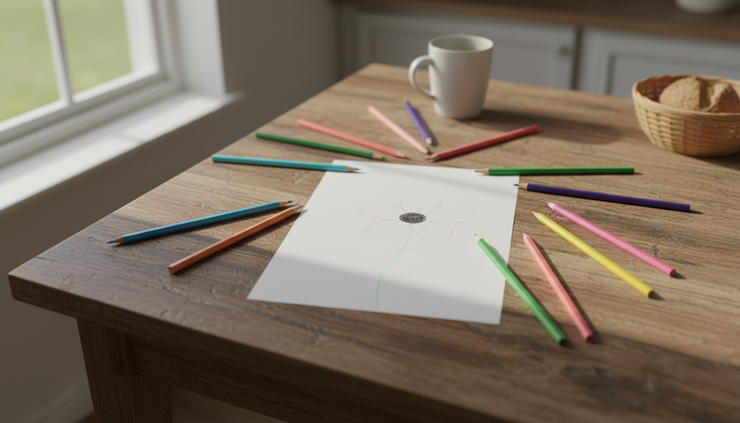
The page is still usable, but the dot deserves care
The black dot lesson is powerful, but it becomes more compassionate when we stop using it to rush people out of their feelings.
Yes, there is usually more white space than we first notice. Yes, one painful mark rarely tells the whole story. Yes, perspective can help us recover, repair, and create something new.
But the dot still matters.
If someone expected a blank page, the mark may feel like loss, interruption, or disappointment. If someone has a history of feeling ignored, the dot may light up an old fear. If someone is tired or stressed, the dot may feel larger than it would on another day.
It's important to remember that people are not machines waiting for better information. They are emotional beings who need safety before they can receive perspective.
In parenting, this means kneeling down before teaching the lesson.
In partnership, it means acknowledging impact before explaining intent.
In friendship, it means saying, “That hurt,” and hearing, “I get why,” before anyone tries to reframe.
The goal is not to stare at the dot forever. The goal is to treat it with enough care that the rest of the page becomes visible again.


Comments